
There are herbs that heal.
And then there are herbs that define civilizations.
Tulsi known internationally as Holy Basil belongs to the second category.
In India, Tulsi is not just grown.
It is respected, protected, and remembered.
Long before global wellness brands, nutraceutical labels, and herbal supply chains discovered Tulsi, it stood quietly in Indian courtyards, absorbing morning prayers, listening to stories of elders, and offering its leaves without demand. Today, the same leaf travels across continents, reaching homes in Europe, America, the Middle East, and Asia carrying with it thousands of years of Indian wisdom.
This is the complete story of Tulsi:
from its natural birth in Indian soil to its role as a global Holy Basil industry.
The Birth of Tulsi (Holy Basil): Creation, Primary Origin, and India’s Natural Abundance

Tulsi did not emerge from laboratories or controlled experiments. It evolved where nature and knowledge met naturally.
Botanical studies and ancient Ayurvedic texts agree on one point:
The Indian subcontinent is the primary origin of Tulsi.
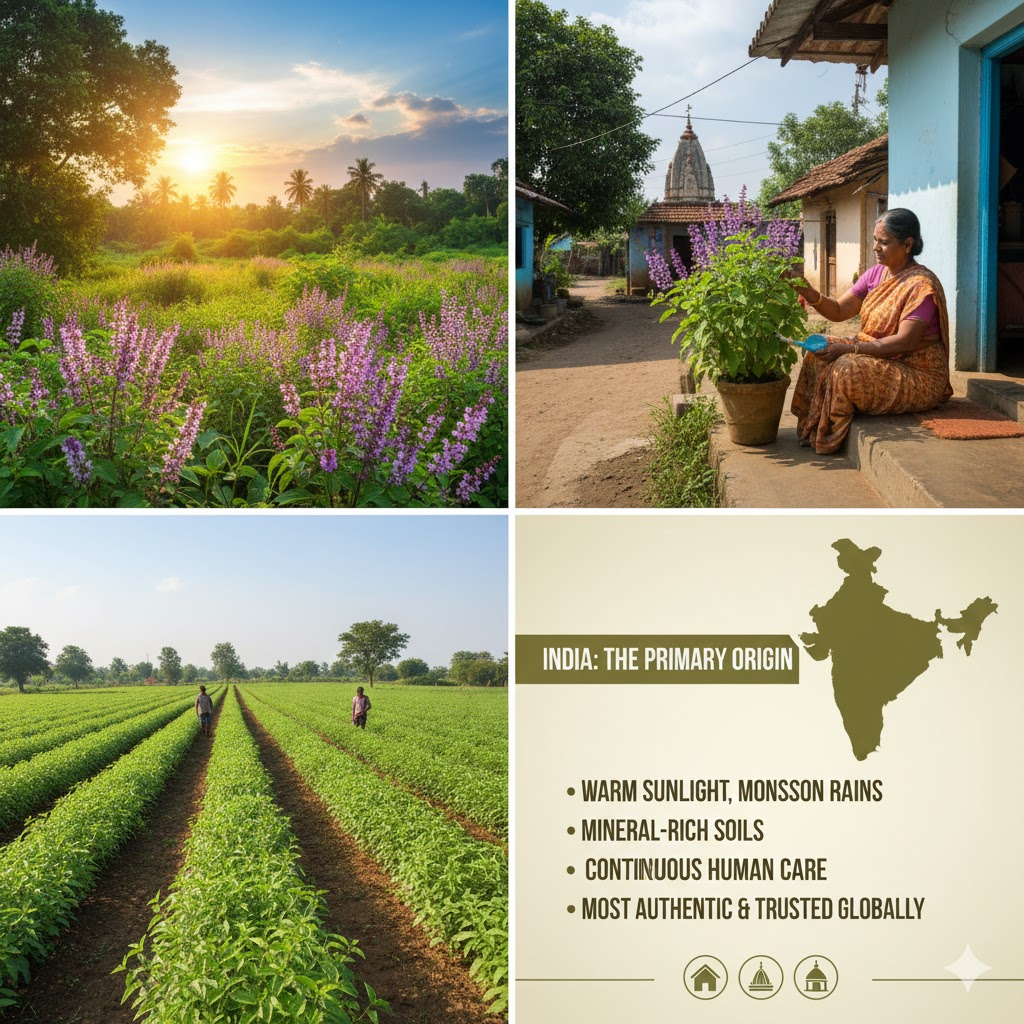
India’s tropical and subtropical climate warm sunlight, monsoon rains, long growing seasons, and mineral-rich soils created the perfect environment for medicinal plants. Tulsi adapted effortlessly to these conditions and began growing naturally in forests, village outskirts, and open lands.
Over centuries, Indians did not just cultivate Tulsi they protected it.
Across India today, Tulsi is available:
In rural and urban households
In temple premises and spiritual centers
In cultivated farms and semi wild landscapes
Across multiple agro climatic zones
This widespread availability is not accidental. It is the result of continuous human care. Unlike many herbs that disappeared and were later rediscovered, Tulsi was never lost. India carried it forward, generation after generation.
That is why, even today, Indian origin Tulsi (Holy Basil) is considered the most authentic and trusted globally.
The Many Faces of Tulsi: Varieties, Botanical Names, and Natural Specifications
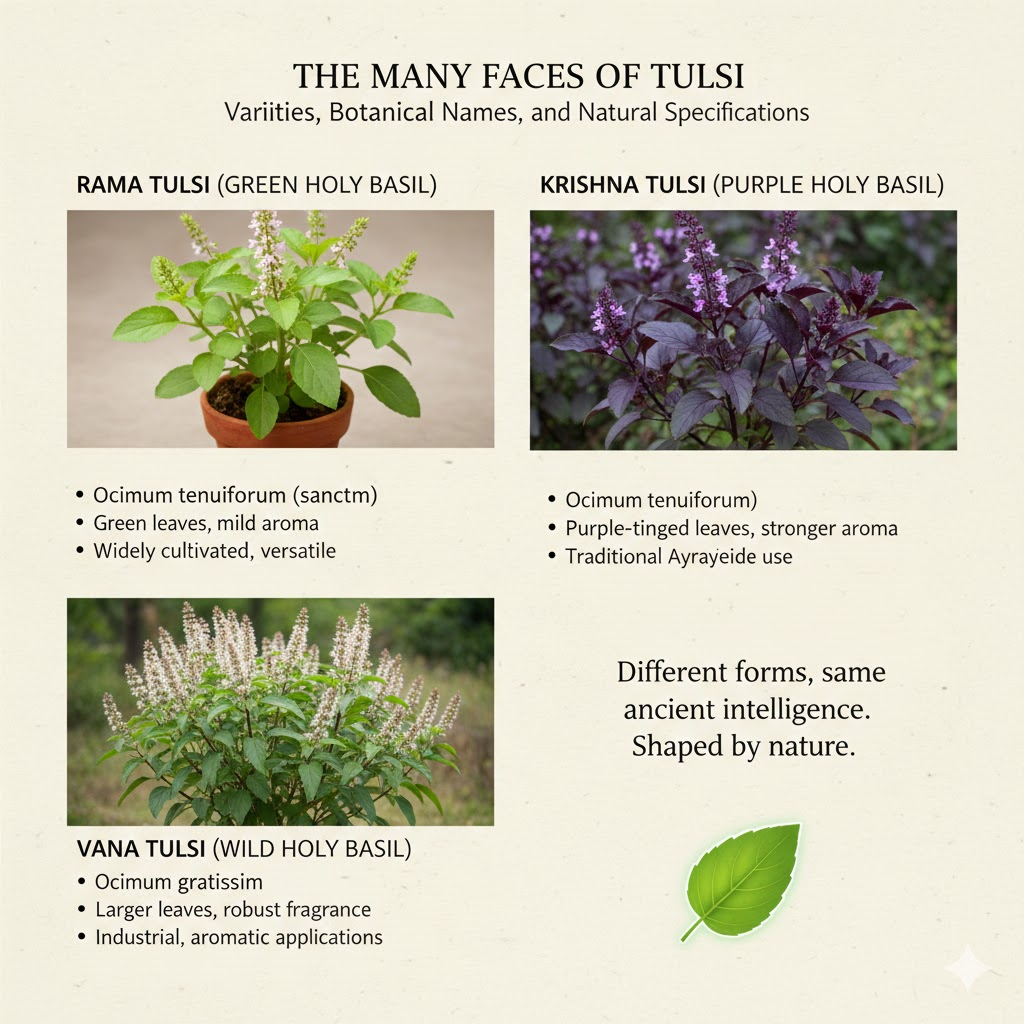
Tulsi expresses itself in more than one form. Each variety reflects a unique interaction between climate, soil, and traditional use.
Rama Tulsi, internationally known as Green Holy Basil, is botanically classified as Ocimum tenuiflorum (earlier known as Ocimum sanctum). It has green leaves, a mild aroma, and a balanced phytochemical profile. Rama Tulsi is the most widely cultivated and commercially preferred variety for herbal teas, nutraceuticals, wellness products, and export markets due to its consistency and adaptability.
Krishna Tulsi, also botanically identified as Ocimum tenuiflorum, carries purple-tinged leaves and a stronger aroma. Traditionally used in Ayurveda, this variety is associated with deeper sensory intensity and is often selected for specialized formulations.
Vana Tulsi, botanically known as Ocimum gratissimum, grows in a more wild and robust manner. Larger leaves, stronger fragrance, and higher essential oil content make it suitable for specific industrial and aromatic applications.
These varieties are not competitors. They are expressions of the same ancient intelligence, shaped differently by nature.
Tulsi in Indian History: From Sacred Plant to Ayurvedic Pillar

To understand Tulsi, one must step into ancient India a time when health was not separated from lifestyle, and medicine was not isolated from nature.
Ayurveda, India’s ancient science of life, recognized Tulsi as a Rasayana a category of herbs that support longevity, balance, and resilience. Ancient Ayurvedic texts describe Tulsi not as a quick remedy, but as a supportive force for long term well being.
But Tulsi’s role was not limited to medicine.
It entered:
Homes as a sacred presence
Temples as a daily offering
Villages as a protected plant
Stories passed through generations tell of sages meditating near Tulsi plants, households beginning the day with Tulsi leaves in water, and communities preserving Tulsi as a symbol of purity and protection.
Tulsi became Ayurveda lived daily, not practiced occasionally.
Tulsi in Ayurveda: Uses, Benefits, and Scientific Understanding

Ayurveda does not ask, “What does Tulsi cure?”
It asks, “How does Tulsi restore balance?”
Tulsi is valued for its adaptogenic nature meaning it supports the body’s ability to adapt to stress, environmental changes, and internal imbalances. Traditional Ayurvedic usage focused on harmony rather than stimulation.
From an Ayurvedic perspective, Tulsi:
Supports digestive balance (Agni)
Helps maintain respiratory comfort
Encourages metabolic harmony
Promotes mental clarity and calmness
Modern science studies Tulsi through antioxidants, essential oils, and bioactive compounds. While terminology differs, the conclusion aligns with Ayurveda’s ancient understanding: Tulsi supports the body instead of forcing it.
In today’s fast paced world, this supportive nature makes Tulsi more relevant than ever.
Tulsi in Everyday Indian Life: Home, Ritual, and Natural Medicine

In India, Tulsi was never limited to clinics or pharmacies. It lived inside daily routines.
Common household practices included:
Adding Tulsi leaves to drinking water
Preparing simple herbal infusions during seasonal changes
Using Tulsi during prayers and rituals
Children recognized Tulsi by its aroma before they could spell its name. Elders trusted it without explanation. Tulsi required no marketing because it was already understood.
This everyday integration preserved Tulsi long before global demand emerged.
Products Made from Tulsi: From Sacred Leaf to Global Wellness Solutions
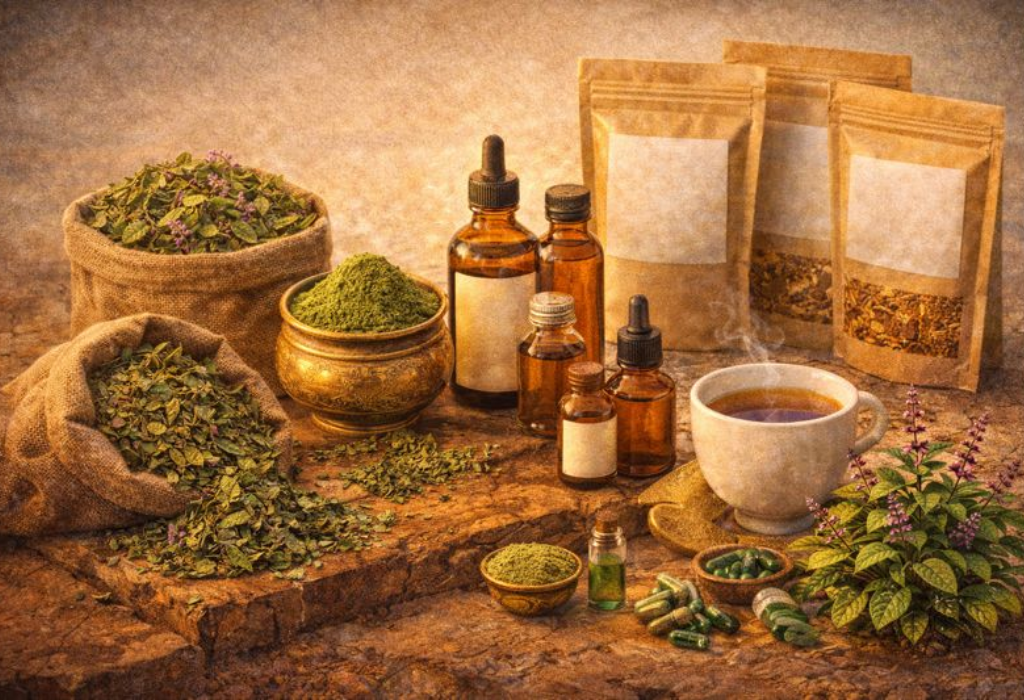
As global wellness awareness grew, Tulsi evolved into diverse product forms while maintaining its identity.
Tulsi is processed into:
Dried whole leaves
Tea cut and crushed forms
Herbal powders
Extracts and concentrates
Essential oils
Herbal tea blends and wellness supplements
Each form serves a specific purpose from traditional Ayurvedic use to modern nutraceutical and wellness applications. Tulsi’s adaptability allows it to fit seamlessly into contemporary lifestyles without losing authenticity.
Industrial Scale Use of Tulsi and Tulsi Based Medicines
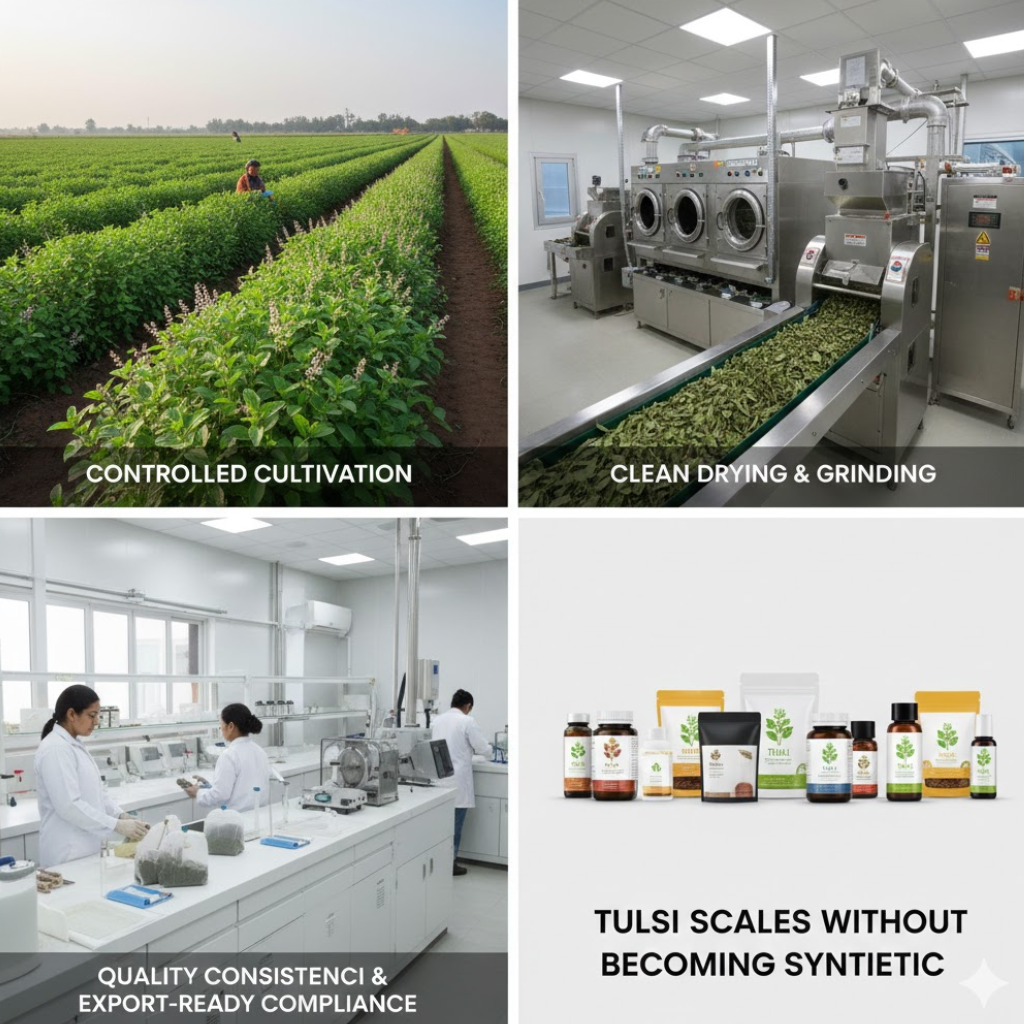
At an industrial level, Tulsi supports multiple sectors:
Herbal and wellness industries
Nutraceutical manufacturing
Botanical raw material supply chains
Traditional medicine formulations
Modern processing emphasizes:
Controlled cultivation
Clean drying and grinding
Quality consistency
Export ready compliance
Tulsi’s industrial success lies in its ability to scale without becoming synthetic a rare achievement among medicinal plants.
Research on Tulsi: From Ancient Scholars to Modern Scientists
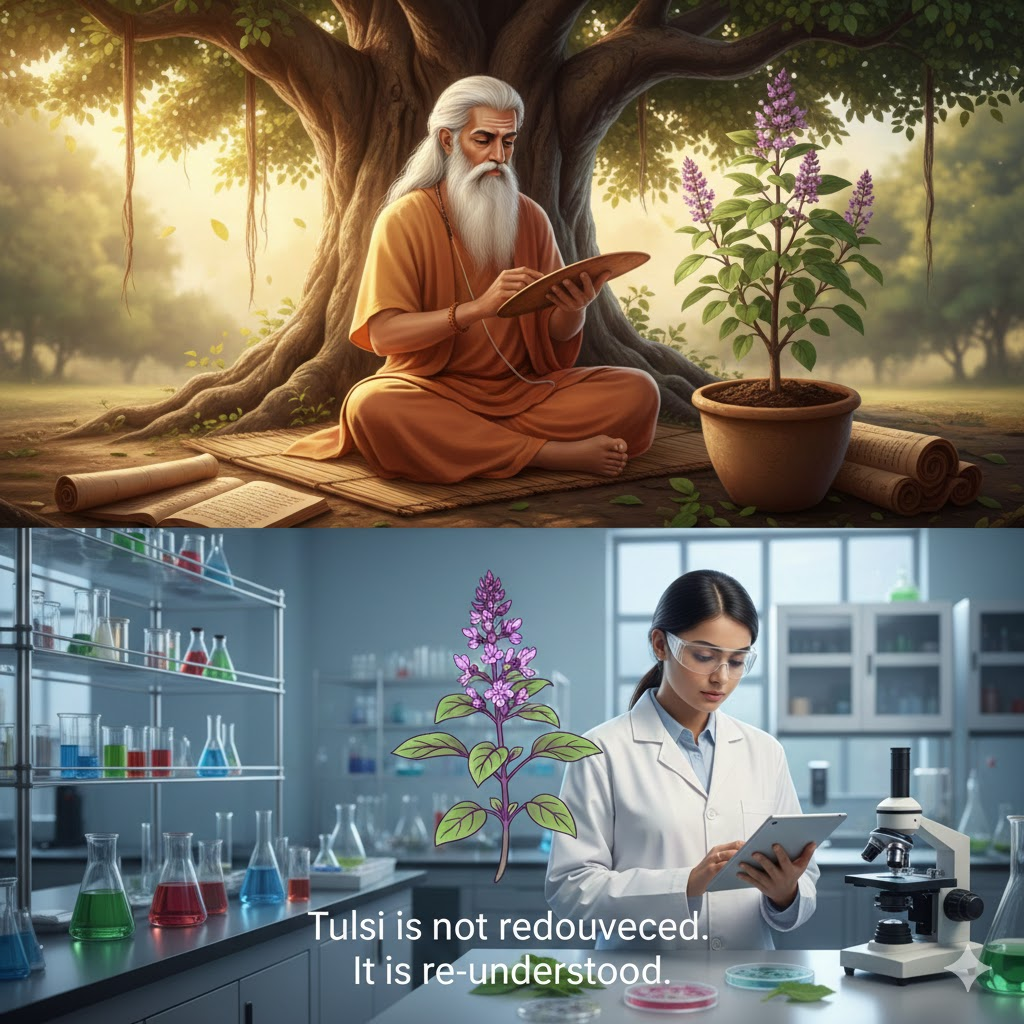
Tulsi has been studied across centuries.
Ancient Ayurvedic scholars documented its properties through observation and experience. Modern researchers in botany, pharmacognosy, and herbal science continue to explore its phytochemical profile and applications.
What makes Tulsi unique is research continuity. Few plants have been respected, studied, and preserved across such a long span of human history.
Tulsi is not rediscovered.
It is re understood.
Tulsi in Today’s Domestic and International Business Landscape

Tulsi in Today’s Domestic and International Business Landscape
Today, Tulsi stands at the intersection of tradition and trade.
Domestically, Tulsi supports:
Households and Ayurveda
Wellness and herbal brands
Internationally, demand is rising across:
Herbal tea markets
Nutraceutical industries
Natural wellness product manufacturers
India remains the most trusted origin for Holy Basil due to:
Authentic cultivation
Farmer knowledge
Favorable climate
Export ready processing
This demand generates wealth through:
Rural employment
Value addition
Sustainable supply chains
True wealth here is regenerative, not extractive.
Why the World Looks to India for Holy Basil (Tulsi)
As global wellness evolves, it seeks authenticity, roots, and continuity. Tulsi offers all three.
India does not need to reinvent Tulsi.
It needs only to present it responsibly.
From ancient sages to modern supply chains, Tulsi’s journey continues calm, balanced, and relevant.
Tulsi serves the world.
But its soul remains Indian.
Our Vision
At Kokan Nakshatra India Exim, we are committed to building traceable, export ready Tulsi (Holy Basil) supply chains, connecting India’s herbal heritage with responsible global buyers while preserving authenticity, quality, and long term value.